
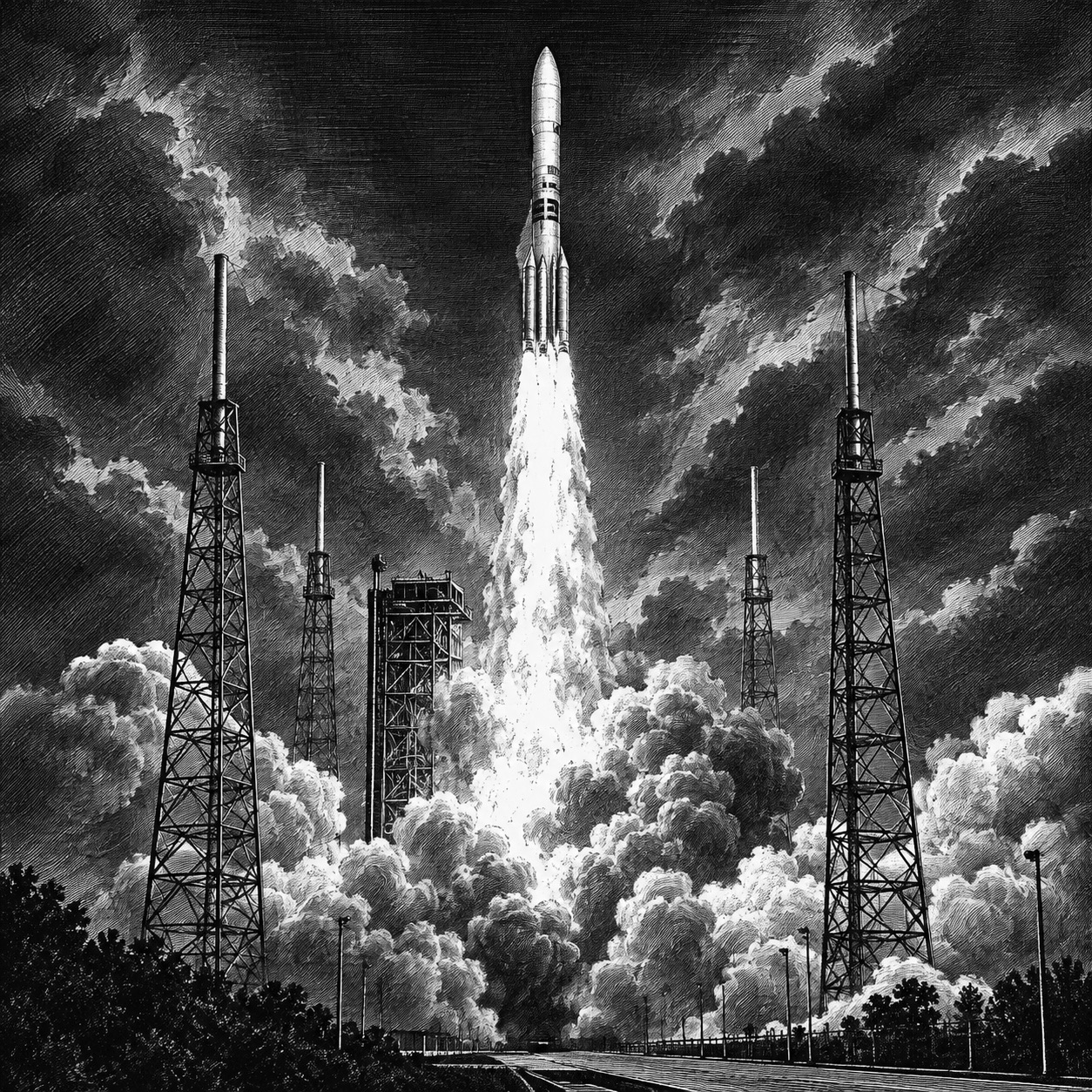
DECATUR, Ala. — An Alabama-built Vulcan rocket failed about 10 minutes after liftoff Sunday, destroying 40 Amazon internet satellites and dealing a setback to a launch program whose main stages, first-stage engines and protective payload shell are manufactured in the state.
The United Launch Alliance rocket lifted off from Cape Canaveral Space Force Station in Florida at 11:40 a.m. CST on Nov. 15. The company confirmed afterward that the mission had failed, but the cause was not immediately known.
“Based on data received by our Launch Director, we confirm that the Vulcan vehicle launched from Space Launch Complex 41 suffered an anomaly 10 minutes into the flight and failed to deliver the Amazon mission to orbit,” ULA said in a statement.
The failure puts a spotlight on north Alabama’s extensive role in producing Vulcan, the company’s successor to its Atlas V rocket. ULA manufactures and assembles the main booster and Centaur upper stage at its Decatur factory. Blue Origin manufactures the booster’s BE-4 engines in Huntsville, while Beyond Gravity produces the payload fairing — the shell protecting satellites during ascent — in Decatur.
Not every major component comes from Alabama. The six solid-fuel boosters used on Sunday’s flight are manufactured by Northrop Grumman in Utah, and the Centaur upper stage’s RL10 engines are manufactured in Florida, according to ULA’s mission documentation.
The company had not identified which component caused the failure. Reuters reported that the malfunction appeared to occur after the upper stage had separated from the first-stage booster, which is powered by the Huntsville-built BE-4 engines. Whether those engines played any role remained unclear.
“Every flight generates data, and every flight teaches us something. Since the anomaly just occurred, we don’t have any specific data yet to understand what occurred today,” ULA said.
The mission, called Vulcan Leo 1, was intended to be the first of 38 Vulcan launches contracted to deploy satellites for Amazon’s Leo broadband network. ULA had previously completed eight successful deployment missions for Amazon using Atlas V rockets, according to the company.
The satellites are part of Amazon’s effort to provide internet service through a network in low Earth orbit, competing with SpaceX’s Starlink system. Before Sunday’s failure, Amazon had deployed 398 Leo satellites across 14 launches, Reuters reported.
Sunday’s flight was Vulcan’s fifth since its 2024 debut and its first in nine months. It followed investigations into problems involving the rocket’s solid-fuel boosters and a separate review involving its BE-4 engines, according to Reuters.
The two previous Vulcan missions delivered their payloads to orbit despite booster problems. The Pentagon had not yet cleared the rocket to resume carrying national security payloads and was awaiting its performance on the Amazon mission, Reuters reported.
The failure therefore has implications beyond the lost satellites. Vulcan is central to ULA’s commercial launch business and its work carrying national security payloads, and the investigation could further delay both schedules. ULA is a joint venture of Boeing and Lockheed Martin.
The setback comes as ULA moves to bring more Vulcan manufacturing under its direct control in Decatur. On Nov. 4, the company announced an agreement to take over Beyond Gravity’s production, engineering and development work for payload fairings and other composite structures.
Beyond Gravity has leased 400,000 square feet inside ULA’s Decatur factory since 2017. More than 300 Alabama-based Beyond Gravity employees will be offered jobs with ULA when the agreement closes, which the company said was expected before the end of the year. The first fairing produced under ULA’s ownership is scheduled to fly in 2027.
ULA said it would work with Amazon and other organizations to determine what went wrong Sunday and identify corrective measures. It did not announce a return-to-flight date.
“We will work closely with our customer and other appropriate organizations to find the cause, determine the appropriate corrective action and return to flight as quickly as possible,” the company said.