
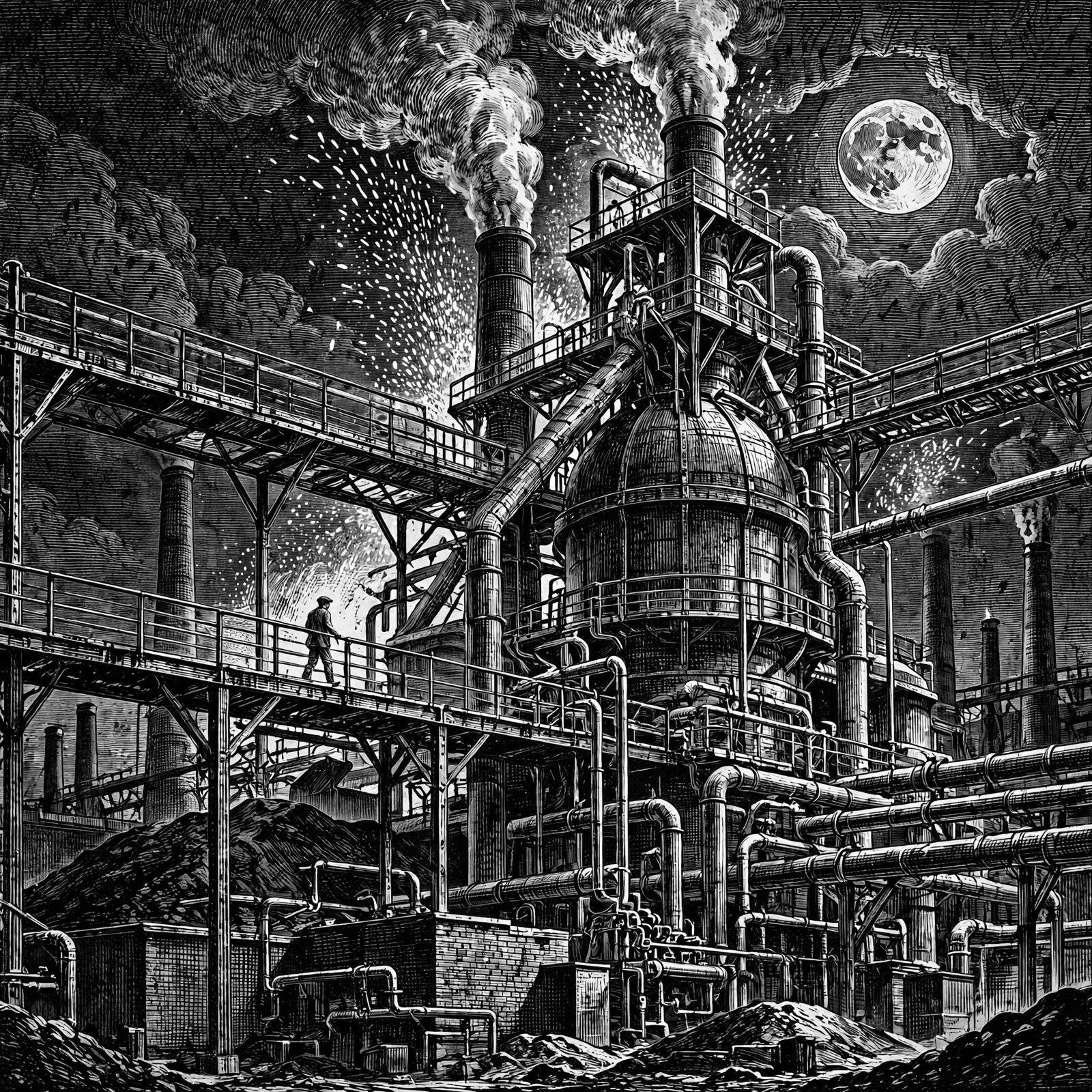
Come Halloween week, folks around Birmingham will tell you about the ghost of Sloss Furnaces. They will tell you his name was James “Slag” Wormwood, that he ran the graveyard shift in the early 1900s, and that he was the cruelest foreman the furnaces ever knew.
The story goes like this. Wormwood drove nearly 150 men through the night shift, sunset to sunrise, forcing them to take dangerous risks to speed up production. In the stifling summer months, temperatures inside the plant climbed past 120 degrees, and the men worked without breaks and without holidays. The story says 47 workers died under Wormwood, ten times more than under any other shift.
Then, in October 1906, the story says Wormwood lost his footing atop Big Alice, the tallest blast furnace, and fell into a pool of melted iron ore. His body melted instantly. The rumor that went around the furnaces was that the men, fed up with their daunting nights, had given him a push.
After that, the story says, the furnaces never quite settled. A watchman in 1926 reported being pushed from behind and told to “get back to work.” Three workmen found unconscious in a small boiler room in 1947 told of a badly burned man ordering them to “push more steel.” Visitors today still report feeling unseen hands on their backs, especially on the catwalk.
It is a fine ghost story. There is only one problem with it. Sloss Furnaces itself says it is not true.
Wormwood was invented in 1998 by the marketers of Sloss Fright Furnace, the haunted attraction held at the furnaces each October. The attraction ran from 1998 to 2019, and its invented foreman proved so convincing that television ghost-hunting shows came calling and the tale spread far beyond Birmingham. In a 2023 statement, Sloss said the story of “Slag” Wormwood is not true, and that most of the reported hauntings found online were fabricated to sell tickets to the attraction.
The ghost outlived the haunted house. That may be the most Birmingham thing about the whole tale: a story made up to sell tickets became the story everybody tells.
But here is the part that needs no invention. Sloss Furnaces was real, and it was hard. The furnaces made pig iron from 1882 to 1971, starting with a first blast in April 1882 that produced 24,000 tons of iron in its first year. The iron built a city almost overnight and gave Birmingham its name as the Magic City. The men who worked the furnaces were mostly poor and desperate for employment, immigrants and Black workers laboring in brutal heat for long hours. That part of the story was never a ghost tale. It was the job.
There is also an older telling, one with deeper roots. It speaks of a foundryman who fell into molten iron at the Alice Furnace across town, and whose ghost was said to have moved to Sloss when that furnace came down. Folklore researchers trace that tale to a real 1887 death at the Alice Furnace. It is a reminder that Birmingham’s furnace country had real tragedies enough without inventing new ones.
Today the furnaces stand as a National Historic Landmark, designated in 1981, serving as an interpretive museum of industry with a nationally recognized metal arts program. Birmingham voters approved $3.3 million in 1977 to preserve the site rather than let it be demolished.
So if you go to Sloss this Halloween week, go for the real haunting. Walk the catwalks where men labored in 120-degree heat. Stand where the iron ran. The furnaces do not need an invented foreman to be worth fearing, or worth remembering. The truth of the place is haunting enough.