

By Riverboat Randy
MOBILE, Ala. — Friends, gather ’round, for I have a tale for you — and this one ain’t spun from river mist. Every bone of it is true, sworn by the record books down in Mobile, and you can go stand beneath the proof yourself any day you please.
In 1833, a young printer named Charles R.S. Boyington stepped off a boat from Connecticut into Mobile, a cotton-boom town growing so fast the streets could hardly keep up. Boyington was a gambler by habit and a newspaperman by trade, lodging in one of the boarding houses that dotted the city, rooming alongside a fellow named Nathaniel Frost.
On May 11, 1834, the two were seen walking together toward Church Street Graveyard on the edge of town. Frost was later found near the cemetery — stabbed to death and robbed. Boyington was the last man seen with him, and in those days that was near enough to a conviction all by itself. The evidence was circumstantial as river fog, but the jury found him guilty all the same, and Boyington went to the gallows protesting his innocence to the very last.
He was hanged on February 20, 1835, and buried in the potter’s field in the northwestern corner of Church Street Graveyard.
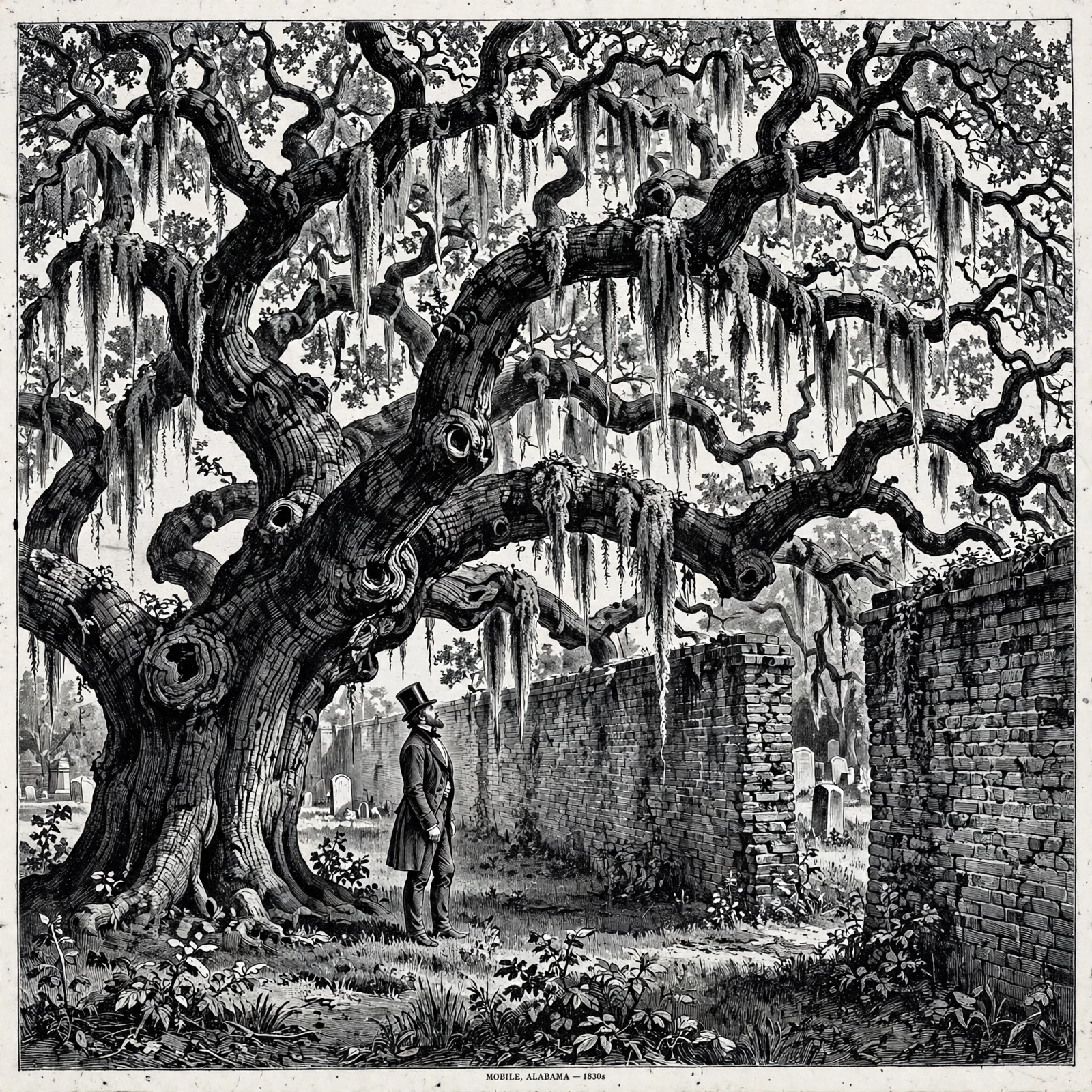
But here’s where the tale turns, friends. Legend holds that before the trap fell, Boyington looked out over the crowd and declared that a mighty oak would spring from his grave as proof of his innocence.
And grow it did.
A southern live oak rose up over that unmarked grave — Quercus virginiana, the kind that lives five hundred years and drapes itself in Spanish moss like an old judge in his robes. When the cemetery’s brick wall was moved back around the turn of the century, the tree was left standing just outside it, on the edge of Bayou Street, where it stands to this day.
Church Street Graveyard itself is worth the trip: four acres established in 1819 and closed in 1898, holding more than 1,100 souls — including Joe Cain, the man who brought Mardi Gras back to Mobile after the Civil War. But it’s the oak outside the wall that draws the visitors. Folks say if you stand quiet beneath its branches, you can hear whispers in the leaves — Boyington proclaiming his innocence still, near two hundred years on. Some swear they’ve seen ghostly shapes moving about the trunk, and there’s talk of a spectral dog that stands watch over the grave and vanishes when approached.
Now, was Charles Boyington innocent? The courts of 1835 said no. The tree has never said a word either way — it just keeps growing, the way the truth has a habit of doing.