
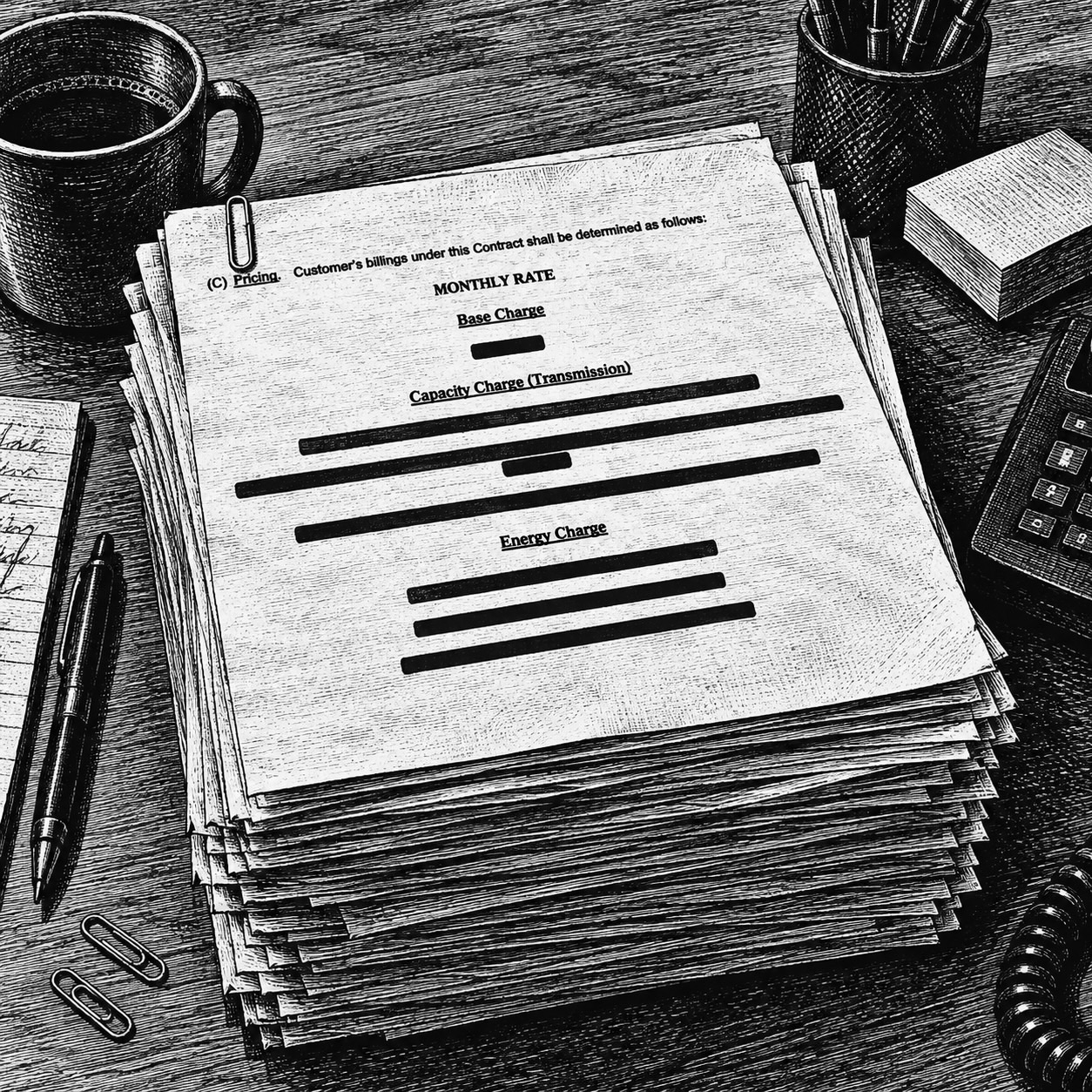
MONTGOMERY, Ala. — Alabama Power is telling regulators that its data center contracts protect customers from higher bills. But every number that would let the public verify that claim is blacked out.
The utility filed three data center contracts with the Alabama Public Service Commission this year. In each one, the contract length, minimum billing requirement, contract capacity and pricing were redacted — the very provisions that determine whether existing ratepayers would be protected if a data center uses less power than promised or walks away early.
The redactions come as a deadline looms. Act 2026-610, passed as Senate Bill 270 and signed by Gov. Kay Ivey, takes effect Oct. 1. The law requires the PSC to determine whether large data center contracts recover the full incremental cost of serving those customers and provide positive benefits to other ratepayers.
But Alabama Power filed a consent agreement in July stating that any contract submitted before Oct. 1 would be judged under the current, interim rules and exempt from whatever new regulations the PSC adopts in Docket 33709. The PSC has not ruled on the docket, and its public calendar shows no meetings scheduled before the deadline.
Alabama Power filed contracts with Dotier, LLC, a subsidiary of Meta, on June 18; Alabama ADC Holdings, LLC, an affiliate of Nebius, on July 24; and Woostor, LLC, on Aug. 14. In each, the same categories of information were blacked out.
The contracts stated: “The Initial Term of this Contract shall be [redacted] years.” For minimum billing: “no less than the greater of (i) [redacted] … or (ii) [redacted] of the applicable Contract Capacity.” Even the names of the people who signed were shielded.
In an Aug. 21 filing, Alabama Power told the PSC that its contracts include initial terms of “more than a decade” and “a billing capacity ratchet of at least 80 percent.” But the proposed rate schedule — the only document that would have the force of law — specifies no minimum term and no minimum bill percentage.
Alabama Power has told the PSC that price is the critical information needed to determine whether retail customers are protected from cost shifts — while maintaining that it will not disclose the price.
Alabama Power maintains that the redactions apply only to the public copy and that PSC commissioners, staff and the Attorney General’s Office all receive the complete, unredacted agreement.
“Redacted from the public copy does not mean withheld from the PSC or the AG’s office,” the utility stated on its website, updated as recently as Sept. 17.
“Large load data center customers pay for their cost of service and do not shift those costs to other customers,” Alabama Power said in its PSC filing. The utility has advertised on Facebook: “Data centers are required to pay the full cost to serve their energy needs so costs aren’t shifted to you.”
Alabama Power’s service area has the highest average residential electric bills in the nation.
Alabama Attorney General Steve Marshall’s office has challenged the PSC’s practice, in place since 1996, of allowing staff to approve large-load contracts without a public vote by commissioners.
Olivia Martin, division chief of consumer interest with the AG’s Office, said commissioners “must actively participate in the decisions of the commission by voting on large load contracts, especially when the matter involves an assessment of public benefits or a determination of the public interest.”
The AG’s office argued that the “deemed-approved” process may be illegal and noted that the PSC has not conducted a formal electricity rate hearing since 1981.
Ratepayer Lucille Kimble-Foster wrote that Alabama Power had “redacted nearly every critical business term.” Without those terms, she said, “the public and the Attorney General’s Office cannot independently verify Alabama Power’s claim that ratepayer costs will not increase.”
Daniel Tait, executive director of Energy Alabama, said: “How much SB 270 actually ends up protecting customers is fully dependent on how the PSC enforces the law. I don’t think the public has a reason to trust Alabama Power when it comes to protecting them from costs.”
Jaclyn Brass, a staff attorney for the Southern Environmental Law Center, called SB 270 “not nearly enough” and advocated “a public and transparent process, like those in other states.”
In other states, comparable terms are public. Indiana Michigan Power’s tariff disclosed a 12-year minimum term and 80% minimum bill. Ohio approved an AEP Ohio structure requiring 85% capacity payment for up to 12 years. Louisiana’s 15-year contract term for Entergy’s agreement with Meta is public. In Alabama, those terms remain blacked out.
While Alabama Power redacted capacity and pricing from the public, its parent company, Southern Company, disclosed similar information to investors. CEO Chris Womack said Alabama Power had “added approximately 3 gigawatts” of contracted data center projects in a single quarter. CFO David Poroch estimated each gigawatt would require approximately $2 billion in new capital.
Alabama Power’s second-quarter profits increased 15% year over year, from $381 million to $437 million.
Alabama Power’s rates are frozen through 2027. But the utility delayed charging customers for a $622 million natural gas plant purchased in 2025 to meet data center-driven demand. That charge is expected in 2028, adding approximately $3.32 per month to the average bill.
“Alabama Power’s own filing shows this isn’t a freeze at all,” Energy Alabama stated. “It’s a delay tactic that shifts costs, shields corporate profits, and leaves customers footing the bill later.”
Foley became the latest Alabama city to impose a moratorium on data center development, with the City Council voting Sept. 9 to approve a six-month halt. In Bessemer, where a proposed 1,200-megawatt campus known as Project Marvel would consume 90 times more energy than all the city’s residences combined, two of five council members who voted for the rezoning lost their seats in August elections. Mayor Kenneth Gulley, who signed a nondisclosure agreement with the developer, faces a runoff.
The PSC has not indicated when it will rule on Docket 33709. The law’s sponsor, Sen. Lance Bell, R-Pell City, said in February that “Alabama families and businesses should never foot the bill for someone else’s private profit.” But in his own Docket 33709 comments, Bell wrote that the PSC’s historical approach “remains effective.”
As the Oct. 1 deadline approaches, the public copy of every contract Alabama Power has filed remains a document of promises with the numbers removed.