
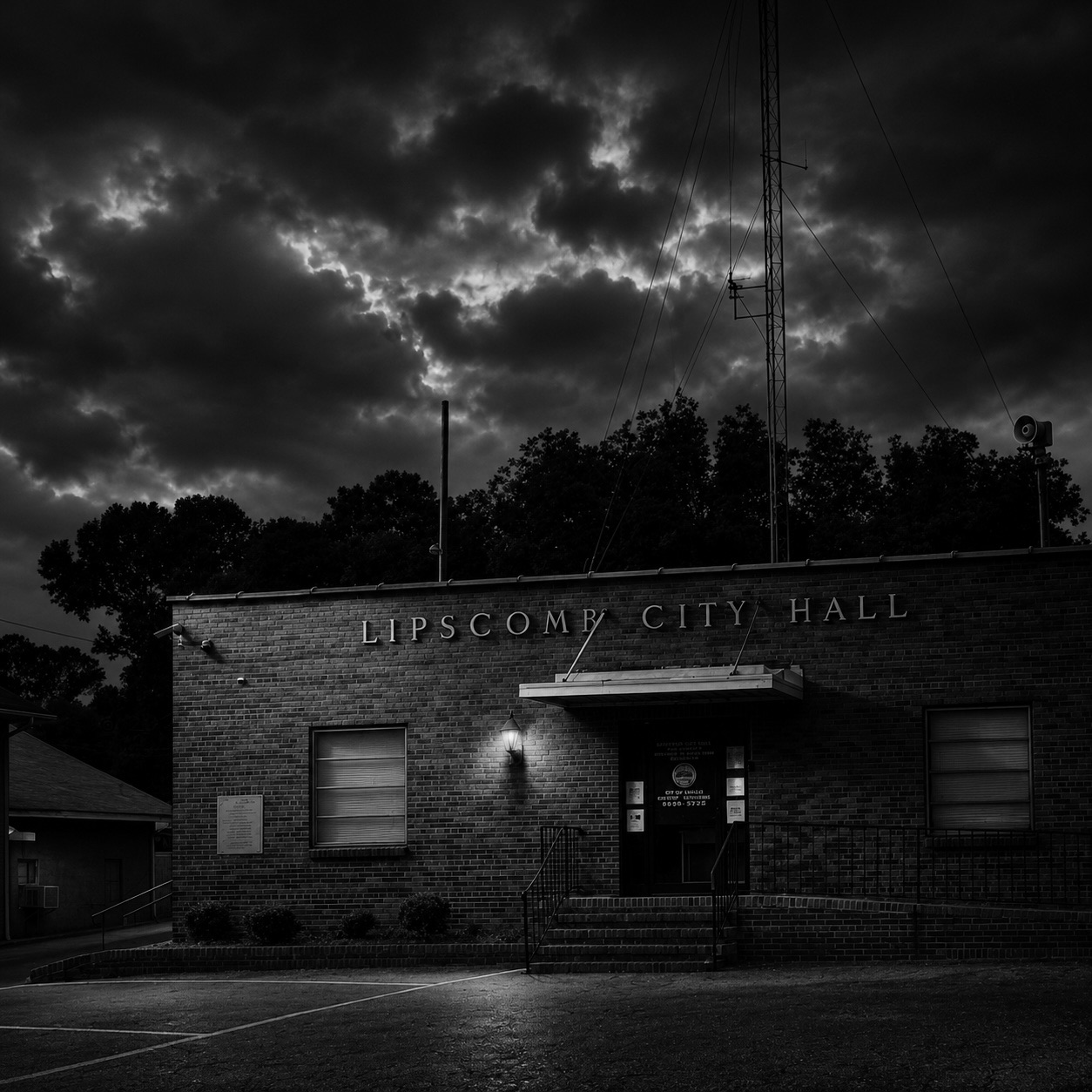
BIRMINGHAM, Ala. — Lipscomb, a small city west of Birmingham, is struggling with a deepening governance crisis as Mayor Rob Sims II faces questions about his attendance and leadership while the town reels from a yearslong financial collapse tied to the loss of bingo hall revenue.
Just weeks after returning to office from a two-month leave of absence, Sims found himself at the center of another dispute during a July 2026 city council meeting when council members objected to him presiding over the session. Council members cited his lack of presence at City Hall and what they described as incomplete or missing documentation needed to manage city business, including insurance applications requiring audits.
The city clerk told the council she “can barely get him to come into the office to sign a login sheet,” raising questions about whether he is working. Sims acknowledged he has not been in the office regularly, saying state law does not require a part-time mayor to keep a daily 9-to-5 schedule.
The friction continues a pattern of conflict that began almost immediately after Sims took office in late 2025, with the city filing a lawsuit against him in March 2026 accusing him of interfering with city operations, including blocking access to City Hall and refusing to complete paperwork needed to formally recognize the police chief with state law enforcement agencies.
Lipscomb’s financial troubles predate the current leadership dispute. In November 2024, Alabama Attorney General Steve Marshall’s office raided Jay’s Charity Bingo, an electronic bingo parlor in the city, and filed a lawsuit that led a judge to freeze all city assets. The freeze meant no money could enter or leave city accounts, leaving the city unable to pay employees or cover basic services.
Marshall contended the city was profiting from illegal gambling operations, noting that Lipscomb had been issuing permits for bingo halls, including those offering electronic games, since at least 2012. Residents and local media reported that the four bingo halls in the tiny city were its only true source of tax revenue, and their closure and the asset freeze left Lipscomb essentially broke.
Even before the freeze, Lipscomb officials had acknowledged the loss of bingo revenue as a major blow to the budget, with former Mayor Tonja Baldwin describing the city as operating on “skeleton shifts” and unable to run at full capacity. Residents also reported unanswered calls to police and gunshots in neighborhoods, underscoring public safety concerns tied to the dwindling police force.
The power struggle between Sims and the council has spilled repeatedly into the courts. In March 2026, a judge ordered Sims to formally recognize several city appointments, including police chief Lanita Neal, city clerk William Baylor and city attorney Wayman Newton, and complete all necessary paperwork within 24 hours.
Despite that order, tensions continued to flare. During a February 2026 council meeting held without the mayor, council members voted to overturn several of Sims’ actions, including his appointment of an acting assistant city clerk and an interim police chief, and nearly arrested the city attorney on a warrant he called “bogus.”
Earlier, in December 2025, a judge issued a temporary restraining order that barred three council members from their duties after Sims argued they lived outside their districts and were ineligible to serve, leaving the council unable to reach a quorum until a hearing the following week. Candidates in that election had campaigned on promises to end the years of internal conflicts, but those pledges quickly unraveled after they took office.
Lipscomb traces its roots to the 1830s, when the area was first settled and a Baptist church established. In the late 19th century, the community was known as Wheeling, named for Stimson Harvey Woodward, a former Wheeling, West Virginia, resident who developed coal mining and blast furnace operations and spurred construction of a local railroad connection.
In 1885, three brothers—S.W., Lawrence Y. and H.P. Lipscomb—settled in the area, and Lawrence Lipscomb opened a general store. By 1890, a rail line connecting the area with Bessemer and Birmingham had been established, and the town became known as Lipscomb Station in his honor. The town was incorporated on June 30, 1910, as Lipscomb.
Proximity to Birmingham and Bessemer, two major industrial centers, attracted workers to Lipscomb, particularly those employed in nearby mines and mills. In the 1940s, Lipscomb incorporated the nearby communities of Gordon Heights and Crescent Heights.
In recent decades, however, the city has experienced a severe population decline, filed for bankruptcy, and in the 2010s curtailed city services due to funding shortages. City officials have repeatedly fended off suggestions to have Lipscomb annexed into Birmingham, and the city celebrated its 100th anniversary in 2010.
As of July 2026, Lipscomb remains in a precarious position, with its mayor under fire for his attendance and leadership, its council locked in legal and procedural battles, and its finances still recovering from the loss of bingo revenue and the state’s asset freeze. Council members say they have had to piece together audits and financial records for 2023, 2024 and 2025 because no prior audits existed, and the city’s previous insurance carrier dropped coverage because of the number of lawsuits involving the city.