
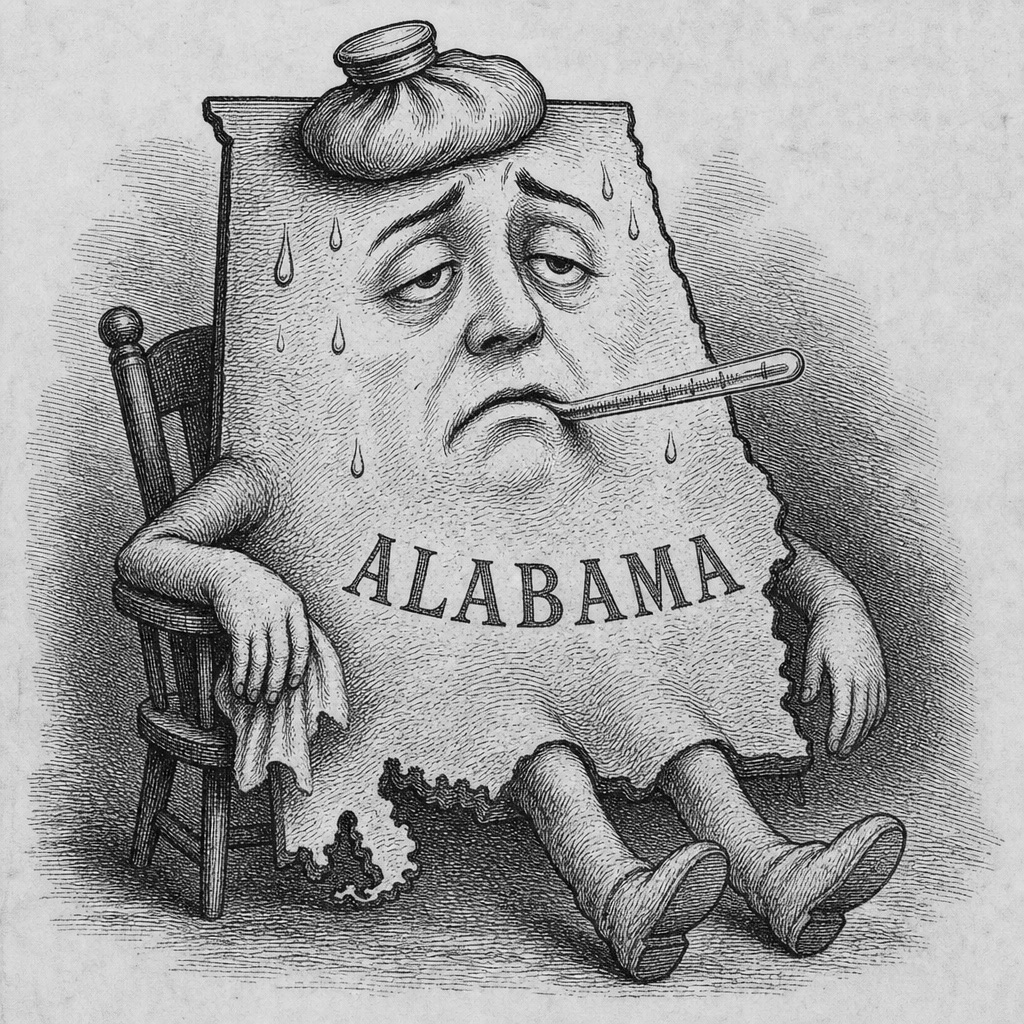
TUSCALOOSA, Ala. — Men in Alabama rank last among all U.S. states in a new national analysis, a finding that local observers say underscores long-standing disparities in health, education and economic opportunity in a state dominated by one-party Republican rule.
The ranking comes from a recent WalletHub report that evaluated conditions for working fathers across 22 metrics, including income, child care costs, work-life balance and health outcomes such as male life expectancy. While the study’s official state-level ranking placed Alabama 47th out of 51 — ahead of only New Mexico, Louisiana, Nevada and Mississippi — a July 9, 2026, story on Tide 100.9, a Tuscaloosa-based radio station, summarized the findings more starkly, stating Alabama men were “ranked dead last” in the nation.
The WalletHub analysis used four dimensions — economic and social well-being, work-life balance, child care and health — to produce its overall score. Alabama scored particularly poorly on health-related measures, including life expectancy for men, a metric in which the state has consistently ranked among the lowest in recent federal data.
Federal statistics show Alabama’s overall life expectancy at birth in 2022 was 73.8 years, tied with Oklahoma, Tennessee and Louisiana for the lowest among states, and well below the national average of 77.5 years. For men specifically, earlier CDC data puts Alabama’s male life expectancy around 72.2 years, compared with roughly 78.2 years for women in the state.
Madison County, home to Huntsville, stands out within Alabama as an area with better outcomes. A 2023 analysis of county-level data found Madison County had an average life expectancy of 77.4 years, about 2.6 years higher than the state average and among the highest in Alabama.
Public health experts have long linked lower life expectancy in Alabama to higher rates of chronic disease, limited access to care in rural areas and lifestyle factors such as smoking and obesity. The state has also struggled with high infant mortality and maternal health challenges, which contribute to overall population health metrics.
Critics say Alabama’s poor rankings reflect more than just individual health behaviors; they point to decades of policy decisions made under a Republican trifecta that has controlled the governor’s office since 2003 and the Legislature since 2010.
The state has declined to expand Medicaid under the Affordable Care Act, leaving an estimated 200,000 Alabamians without affordable health coverage. Education funding has lagged behind national averages, and teacher pay ranks among the lowest in the nation, factors that researchers associate with poorer long-term health and economic outcomes.
In 2026, the Republican-controlled Legislature advanced measures to close primary elections to independent voters, a move supporters say strengthens party organization but opponents argue further entrenches one-party rule and reduces electoral competition.
Alabama’s political landscape has grown more uniformly conservative in recent years, with Republicans holding every statewide elected office and supermajorities in both legislative chambers. The National Conference of State Legislatures notes that Alabama is among 15 states that do not require voters to register with a party, though a 2026 bill sought to change that starting in 2027.
Not all of Alabama fares equally poorly. Madison County’s higher life expectancy and stronger economic indicators — driven in part by the presence of federal agencies, defense contractors and the University of Alabama in Huntsville — illustrate how investment in education and high-tech industries can improve outcomes.
Shelby County, which includes affluent suburbs of Birmingham, also tends to outperform much of the state on health and income measures, though disparities persist along racial and geographic lines. Rural counties in the Black Belt region continue to face some of the worst health and economic conditions in the nation.
Health advocates and policy analysts say closing Alabama’s health and economic gaps will require expanded access to care, increased investment in education and early childhood programs, and efforts to diversify the state’s economy beyond traditional industries.
Some point to states at the top of WalletHub’s working-dad ranking — Massachusetts, Connecticut, the District of Columbia, New Jersey and Rhode Island — as models. Those states combine higher median incomes, lower child poverty rates, stronger school systems and more generous family leave policies.
Massachusetts, which topped the 2026 WalletHub list, also records one of the highest male life expectancies in the nation and has pursued policies such as near-universal health coverage and paid family leave.
As Alabama begins another legislative session in 2027, the state’s last-place ranking for men is likely to fuel debates over health care access, education funding and economic development. Lawmakers face pressure to address disparities that have persisted for decades, even as some counties demonstrate that better outcomes are possible within state borders.
For now, the WalletHub findings and the Tide 100.9 coverage have renewed attention on a question that has long shadowed Alabama: why its men, and its families, continue to lag behind much of the rest of the country.