
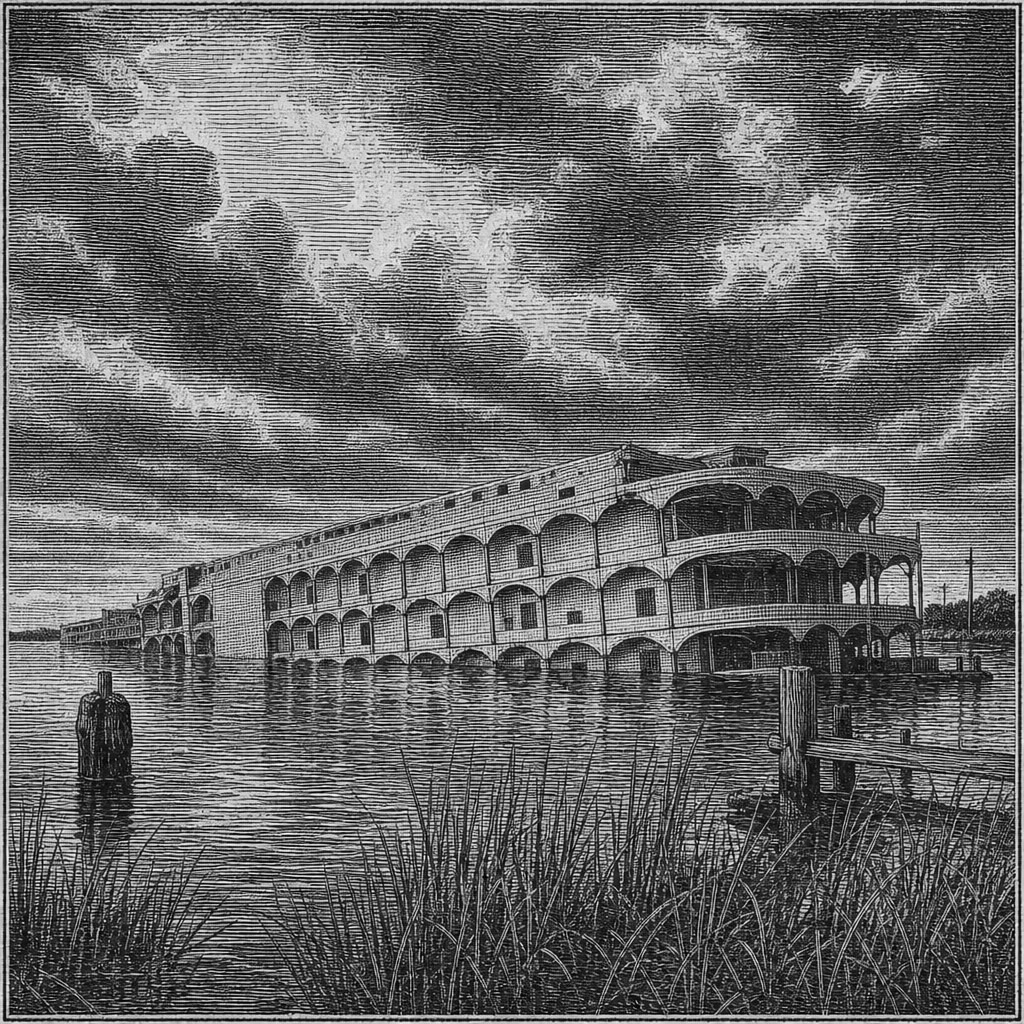
ORANGE BEACH, Ala. — A former Ohio River casino riverboat that once billed itself as the world’s largest was intentionally sunk off Alabama’s Gulf Coast this week to become one of the state’s biggest artificial reefs, adding to a program that dates to the 1950s and now spans more than 1,100 square miles of offshore waters.
The 408-foot Argosy VI went down at about 10 a.m. Wednesday, July 1, 2026, in roughly 120 feet of water about 23 nautical miles south of Orange Beach, settling upright with its top deck about 60 feet below the surface, according to the Alabama Department of Conservation and Natural Resources.
The vessel, which operated as a floating casino on the Ohio River in Lawrenceburg, Indiana, until 2009, was purchased by the state for $2.5 million using Gulf of Mexico Energy Security Act (GoMESA) funds and prepared for sinking in Bayou La Batre, where crews removed hazardous materials and cut large openings to allow water to flood the hull in a controlled descent.
The Argosy VI now joins two other large, diver-friendly wrecks — the 271-foot Lulu and the 250-foot New Venture — within about 7½ miles of each other in the 364-square-mile Dr. Robert (Bob) Shipp Alabama Artificial Reef Zone, creating what state officials have long described as a planned “trifecta” of big-ship reefs to support fishing and diving tourism.
Conservation Commissioner Chris Blankenship said in a written statement that the sinking “completes the dream we started back in 2013 with the reefing of the 272-foot-long Lulu,” adding that the Marine Resources Division and the Alabama Gulf Coast Reef and Restoration Foundation had aimed to build three large ship-size reefs in close proximity to draw dive operators and fishing businesses.
Craig Newton, a supervising biologist with the Marine Resources Division, said the Argosy’s 80-foot beam and multi-deck layout will create more vertically complex habitat than the older Liberty ship wrecks sunk in the 1970s, which are about 440 feet long but only around 50 feet wide.
“You can get some transitory fish within a couple of hours,” Newton said of how quickly marine life typically begins using new reefs. “It will probably be about a year before we have a complete community of species designated only to this reef.”
State officials expect the structure to attract red snapper, greater amberjack, gray snapper, grouper, gray triggerfish and vermilion snapper, while also serving as a long-term dive destination for a range of experience levels.
The Argosy VI was built as a four-level, barge-style riverboat casino and began operating in Lawrenceburg, Indiana, on Dec. 13, 1996, under the name Argosy Casino, according to Indiana gaming records and news reports.
Operated by Argosy Gaming Co., the boat once held the title of the “world’s largest riverboat casino,” with capacity for more than 4,400 guests and space for more than 1,700 slot machines, Cincinnati-area media reported.
In 2004, Penn National Gaming (now Penn Entertainment) acquired Argosy Gaming, and in June 2009 the property was rebranded as Hollywood Casino Lawrenceburg after a larger, newer riverboat replaced the original vessel, according to Indiana gaming documents and news accounts.
The older Argosy VI was then moved to Alabama, where it sat docked in Bayou La Batre for years before being selected for the artificial reef program.
Alabama’s artificial reef effort began in 1953, when the Orange Beach Charter Boat Association asked for permission to sink 250 car bodies off Baldwin County to create fishing structure, a project that proved successful and led to the use of culverts, bridge rubble, barges, boats and planes as reef material, state records show.
In 1974–75, several decommissioned World War II Liberty ships were sunk in five locations off Mobile and Baldwin counties in 80–93 feet of water, forming some of the earliest large-ship reefs in what is now the Dr. Robert (Bob) Shipp zone.
A general permit from the U.S. Army Corps of Engineers in 1987 established specific offshore areas for artificial reefs, and the program has expanded repeatedly since, including the deployment of 100 decommissioned military tanks in 1994 under the REEF-EX program and the addition of multiple designated reef zones in subsequent decades.
Today, Alabama’s Marine Resources Division manages more than 1,100 square miles of artificial reef areas containing more than 12,000 structures, making it the largest artificial reef program in the United States, according to the department.
Recent projects have included pyramid-shaped concrete and limestone modules deployed in the Christopher Blankenship Reef Zone and AWF Nearshore Artificial Reef Zone to protect juvenile reef fish, as well as the “Rigs to Reefs” program that repurposes decommissioned oil and gas platforms.
The Argosy VI is expected to remain a productive reef for 30 to 50 years, providing habitat and recreational opportunities for anglers and divers for decades, state biologists said.