
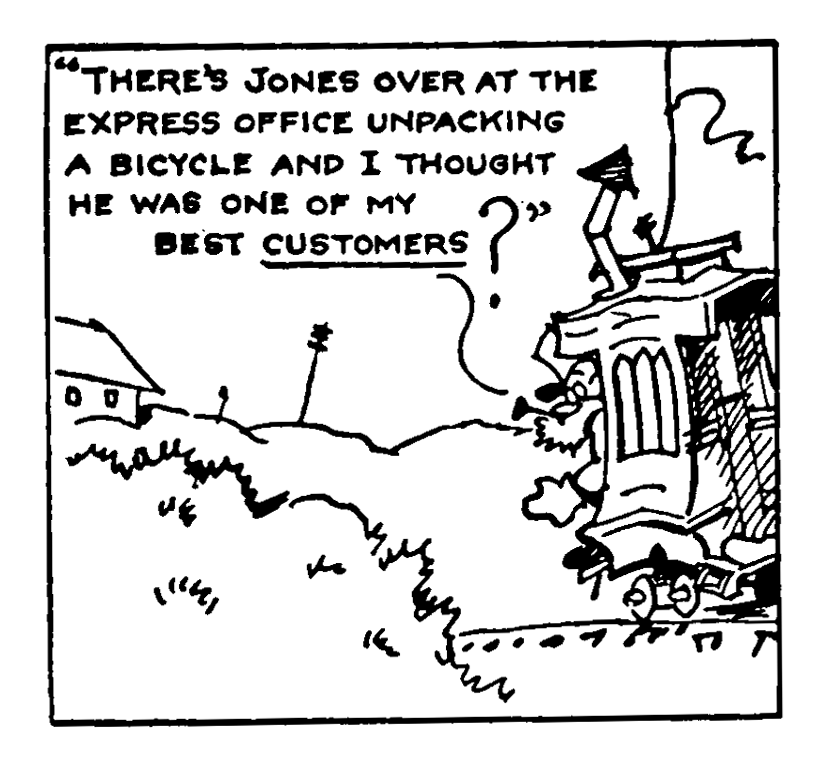
Fontaine Talbot Fox Jr., born June 4, 1884, in Louisville, Kentucky, drew one of the longest-running and best-loved comic features in American newspapers. His Toonerville Folks, built around a rickety little trolley and the people who rode it, appeared in the Chicago Evening Post, was syndicated nationally by the Wheeler Syndicate in 1913, and ran in 250 to 300 newspapers across North America until Fox retired on Feb. 12, 1955.

Fox was the son of a Louisville lawyer. He graduated from Louisville Male High School in 1904, where he worked on the school newspaper and drew for its literary journal, and went to work as a reporter and part-time cartoonist for the Louisville Herald. In 1905 he entered Indiana University, where he joined Sigma Chi and kept drawing a cartoon a day for the Herald. After two years he left college for cartooning, returned to Louisville to draw for the Herald and then the Louisville Times, and in 1910 went to Chicago to draw for the Chicago Evening Post. The panels that became Toonerville Folks began appearing in the Post, and by 1913 the Wheeler Syndicate was carrying them to newspapers across the country.

Fox traced the idea for the trolley to a visit to Pelham, New York, in 1909, when he and his wife went to see the cartoonist Charlie Voight. At the station they found a rattletrap streetcar run by a wistful old codger with an Airedale beard, a man who gossiped with his passengers and once stopped the car to pick apples for them. Fox told the story himself in The Saturday Evening Post in 1928, writing that the skipper “showed as much concern in the performance of his job as you might expect from Captain Hartley when docking the Leviathan.” Louisville has its own claim on the strip: the city says the model was the short Brook Street trolley line, whose cast-off cars and haphazard schedule were a local joke, and that the managing editor of the Herald once asked the young Fox to caricature them.

The feature was a daily look at Toonerville, a small town somewhere in the suburbs, and at the center of it was the Toonerville Trolley that meets all the trains, driven in a frenzy by the grizzled old Skipper to meet each commuter train as it arrived. Around the trolley Fox built the largest cast ever seen in a comic strip, 53 characters in all, each one grotesquely exaggerated and instantly recognizable.

They included Mickey (Himself) McGuire, the town bully; the Powerful Katrinka, who sometimes single-handedly hoisted the wayward trolley back onto its tracks; the Terrible-Tempered Mr. Bang, said to be modeled on Fox’s own father; Aunt Eppie Hogg, the fattest woman in three counties; Suitcase Simpson; the Little Scorpions; “Stinky” Davis; and Little Woo-Woo Wortle. Readers followed them the way they followed the characters in movie serials and radio soap operas, and Fox could leave a character out for weeks and bring him back without a name and be sure readers would know him.

Fox’s drawing looked simple at first glance, but it was full of tricks. The vehicles and telephone poles lean at odd angles, and frequently so does the horizon. He drew the town from a slight aerial perspective, as if the reader were looking down on it, so the whole gag could be taken in at once. Fox once summed up his own rule for a cartoon: “In drawing a cartoon I always try to keep three things in mind — it must have an original thought: it must be something that has happened or could happen: and it must be laughable. That’s all there is to it!”

Toonerville was one of the most popular comics of the World War I era, and it sold. The feature spawned cartoon books, cracker boxes, magic picture folders, paper masks, gum wrappers, bisques and cutout sheets, and its characters turned up for decades in advertisements for Drano, Kellogg’s cereals and Chef Boyardee foods. Comic book reprints of the panel appeared in All-American Comics, Famous Funnies and Popular Comics between 1934 and 1940.

Hollywood came calling, too. Between 1920 and 1922, Fox wrote 17 two-reel Toonerville silent film comedies for the Betzwood studio near Philadelphia, starring Dan Mason as the Skipper and Wilna Hervey as Katrinka. Only seven of them survive today. In 1936, Van Beuren Studios made three animated Toonerville shorts for its Rainbow Parade series — “Toonerville Trolley,” “Trolley Ahoy” and “Toonerville Picnic” — with Katrinka animated by a young Joseph Barbera.

The strip’s biggest star off the page was Mickey McGuire. More than 55 low-budget Mickey McGuire comedy shorts were filmed between 1927 and 1936, starring a child actor named Joe Yule Jr. in the role. Yule took the character’s name as his own professional name, but when he and the part went their separate ways, Fox would not let him go on performing as Mickey McGuire. The boy changed his name once more, to Mickey Rooney.

Fox changed syndicates twice over the years, passing from the Wheeler Syndicate to the Bell and McNaught syndicates, and in time he gained all rights to his own strip.

He was also an author and a fervent golfer who won several tournaments, and he published three books of his own cartoons — Fontaine Fox’s Funny Folk in 1917, Fontaine Fox’s Cartoons in 1918 and The Toonerville Trolley and Other Cartoons in 1921 — and illustrated books for the humorist Ring W. Lardner, including Bib Ballads and Own Your Own Home.
When Fox retired in 1955, he refused to let his creation pass into another cartoonist’s hands. The last Toonerville Folks panel ran on Feb. 12, 1955. He had moved to New York City years before, and in the 1940s he lived in Greenwich, Connecticut, spending winters in Delray Beach, Florida.

He retired to Vero Beach, Florida, and died in Greenwich on Aug. 9, 1964, at the age of 80. Fox is often credited with the epitaph, “I had a hunch something like this would happen,” though his gravestone bears no epitaph at all.
Toonerville outlived its creator. In 1972, Herb Galewitz and Don Winslow compiled Fontaine Fox’s Toonerville Trolley, a 184-page book of daily panels. In 1995, the strip was one of 20 included in the U.S. Postal Service’s Comic Strip Classics series of commemorative stamps. Four American communities — in Colorado, Kentucky, Missouri and Pennsylvania — took the name Toonerville from the strip.

The cartoonist Friz Freleng based the Looney Tunes character Yosemite Sam in part on the Terrible-Tempered Mr. Bang, and Fox’s work influenced a later generation of cartoonists, among them Hank Ketcham and Stuart Hample. The panels printed here come from The Smithsonian Collection of Newspaper Comics. The last is dated Dec. 21.