
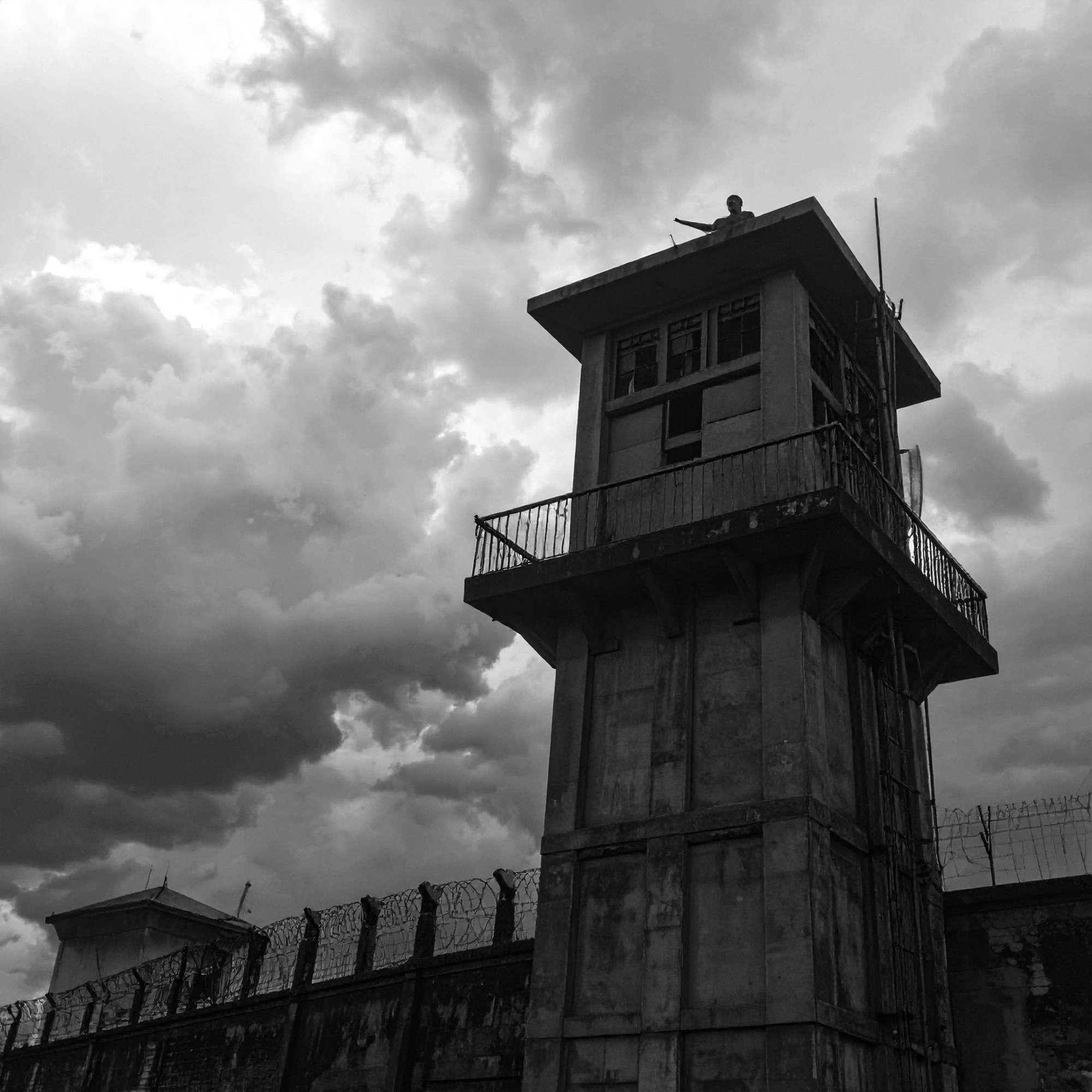
HUNTSVILLE, Ala. — A handcuffed prisoner was lifted from the ground and slammed repeatedly onto concrete, leaving him unconscious and unable to breathe on his own. Another man was hospitalized with 26 stab wounds to his stomach. A sleeping prisoner suffered severe burns after another prisoner poured a microwaved mixture of baby oil, shaving powder and coffee over his face and body, federal investigators alleged.
Those accounts form part of the federal government’s case against Alabama’s prison system for men, which is scheduled to go to trial Nov. 30 after years of warnings that prisoners face unconstitutional violence, sexual abuse and excessive force by correctional officers.
The civil trial in Huntsville will test whether Alabama has systematically violated the constitutional rights of the people it imprisons — and whether a federal judge must order changes to protect them. The Justice Department is seeking an injunction, not monetary damages. Its allegations must be proved in court.
More than seven years after federal investigators first formally notified Alabama of their findings, the state’s own auditors have documented failures that echo the federal allegations: inadequate oversight, dirty living quarters, obstacles to obtaining records and an officer who remained employed despite repeated excessive-force incidents.
Alabama’s record stands out even within a country where other prison systems have faced federal findings of extreme violence.
The Justice Department sued Alabama and its Department of Corrections in December 2020 after an investigation and more than 20 months of negotiations failed to produce a settlement. Federal officials alleged that Alabama failed to protect prisoners from assaults and sexual abuse, maintained unsafe and unsanitary conditions and subjected prisoners to excessive force by staff.
The government’s July 2020 excessive-force report described a September 2019 incident at Ventress Correctional Facility in which a lieutenant repeatedly slammed a handcuffed prisoner onto a concrete floor. The prisoner required intubation, and medical personnel performed CPR several times to keep him alive, investigators reported.
The government’s complaint also described the March 2020 hospitalization of a prisoner with 26 stab wounds and the August 2020 burning of a sleeping prisoner at Easterling Correctional Facility. Those incidents were presented as evidence of broader failures of supervision and security, rather than isolated episodes.
Federal investigators linked the danger to overcrowding, critically low staffing, ineffective prison management, inadequate reporting and an inability to control weapons and illegal drugs. The lawsuit alleges that state officials knew about the risks but failed to address them adequately.
The case centers on the Eighth Amendment’s prohibition against cruel and unusual punishment. U.S. District Judge Harold Mooty III will hear it without a jury. He has said the trial could take six weeks and has reserved eight weeks on his calendar, according to Alabama Appleseed’s account of a pretrial hearing.
A 367-page state audit released Nov. 6 examined the Department of Corrections’ central office and Kilby Correctional Facility, an intake prison near Montgomery. Examiners described “an underlying sense of secrecy within the agency, whether perceived or actual,” according to the Alabama Reflector’s reporting on the audit.
Auditors said records that should have been readily available were not, and they ultimately issued a subpoena to obtain some material. They recommended leadership that would promote a fundamental change in the department’s culture.
At Kilby, examiners found dirty housing areas, dead insects, mold and mildew, and bathrooms with broken showers, toilets or sinks. Prisoners reported inadequate cleaning supplies, and facility leaders said the department’s central office had sometimes denied requests to buy additional supplies, the audit found.
The review also identified a failure to impose the discipline required by department policy on an officer with repeated excessive-force incidents. Documentation of an earlier incident was missing from the disciplinary section of the officer’s file, allowing the officer to avoid termination after another violation, auditors found. The officer remained employed with three excessive-force incidents over the course of the officer’s career.
At the department’s central office, auditors found a handwritten “be back soon” note on the surveillance-room door. The employee responsible for monitoring cameras from prisons statewide was elsewhere folding prisoner uniforms, according to the audit.
Corrections Commissioner Greg Lovelace disputed some conclusions and cautioned against drawing broad judgments from limited samples and observations made during particular visits. He said improvements in staffing, training, supervision and technology were underway.
“ADOC does not agree with every conclusion or recommendation in the report, but disagreement should not be mistaken for resistance to oversight,” Lovelace wrote in the response quoted by the Reflector.
Alabama Appleseed, a criminal justice reform organization, reported obtaining records showing at least 202 deaths in Alabama prisons in 2025. It calculated a mortality rate of 957 deaths per 100,000 incarcerated people. Those were deaths from all causes, not a count of people killed in assaults.
For historical context, the Bureau of Justice Statistics reported a nationwide state-prison mortality rate of 330 per 100,000 prisoners in 2019. Alabama’s reported 2025 rate was nearly three times that figure, but the comparison spans six years and should not be treated as a current, same-year national ranking.
A separate Equal Justice Initiative analysis examined Alabama’s 2023 deaths using age-adjusted rates, which account for differences in the ages of the populations being compared. It calculated a prison homicide rate of 92.5 per 100,000, compared with 15.1 among Alabamians outside prison — roughly six times as high.
The organization also calculated substantially higher overdose and suicide rates in prison. It warned that the findings could understate the toll because causes of death remained unreported for some people more than a year after they died.
Alabama is not alone in facing evidence of systemic brutality.
In Georgia, a Justice Department investigation released in October 2024 found that the state failed to protect incarcerated people from extreme violence. Georgia reported 142 prison homicides from 2018 through 2023, including 35 in 2023. Federal investigators said the state’s inadequate tracking likely understated the number.
Georgia reported 48 homicides during the first three years of that period and 94 during the final three — nearly a doubling. Investigators also found discrepancies between Georgia’s publicly reported homicide figures and other records documenting deaths.
Those findings show that Alabama’s crisis is part of a broader problem, but raw totals cannot establish which system is more dangerous without accounting for the size of the prison population and consistent definitions of homicide.
Recent figures from England and Wales provide one overseas benchmark, though not a perfectly matched comparison.
Their prison system recorded 360 deaths in the 12 months through September 2026, a rate of 4.2 per 1,000 prisoners, according to the British Ministry of Justice. That is equivalent to 420 per 100,000 — less than half Alabama’s reported 2025 rate of 957 per 100,000.
The figures cover different periods and have not been adjusted to make the populations equivalent in age, health or other characteristics. They illustrate a substantial difference in reported overall mortality, not proof that every category of death is more common in Alabama.
England and Wales also reported five prison homicides in the year through September 2026. Their system is not free of serious violence: Ministry of Justice data recorded 244 prisoner-on-prisoner assaults per 1,000 prisoners in the year through March 2026. That figure counts incidents, not the percentage of prisoners assaulted.
European prisons also face overcrowding. The Council of Europe’s 2024 prison survey identified severe overcrowding in Slovenia, Cyprus, France, Italy, Romania and Belgium. France reported 124 prisoners for every 100 available places; Italy reported 118.
By comparison, Alabama’s Kilby prison held 1,389 people during the recent state inspection in a facility originally designed for 440, according to the audit. The department listed its current bed capacity as 1,461 — a distinction showing why original design capacity and an agency’s current capacity figures cannot be used interchangeably.
The Council of Europe cautions that international comparisons can be distorted by differences in who is counted, how capacity is defined and how deaths and other incidents are recorded. Its figures do not support a simple global ranking of the world’s most brutal prison systems.
Alabama is constructing a 4,000-bed men’s prison in Elmore County, part of a building program state officials have pursued as aging facilities face scrutiny. The project has experienced repeated delays and rising costs.
But the state audit raised a question that new construction alone cannot answer: whether the department will change how it supervises officers, documents violence and responds when prisoners are harmed.
“It starts from the top, and we’ve got to change the culture of the Department of Corrections,” state Sen. Larry Stutts, R-Tuscambia, told the Reflector. “We can’t move into a new facility and take the old culture with us.”
At the pretrial hearing, Mooty warned against intimidation of witnesses, including incarcerated people expected to testify about conditions inside the prisons. They “must be allowed to testify freely,” he said, according to Alabama Appleseed.
Their testimony will help determine whether years of documented danger amount to a continuing constitutional violation — and what Alabama must do to stop it.