
Charles M. Payne was one of the busiest cartoonists of the early newspaper age, and one of the most practical. He spent almost seventy years in the business, hopping from paper to paper, and he had a trick no one else tried twice: he sold nearly identical strips to two different newspapers at the same time.

Payne was born in 1873 in East Brady, Pennsylvania, and came to Pittsburgh as a young man, sending cartoon ideas to the local papers until one of them hired him. The Pittsburgh Post took him on as a cartoonist in 1896. Two years later he moved to the Pittsburgh Chronicle Telegraph, and in 1900 he moved again, to the Pittsburgh Gazette-Times. Three papers in four years — a pace he would keep for the rest of his career.

In all of his early newspaper cartoons, Payne ran a little raccoon character as a gag, and he signed some of his work with the pseudonym “Coon,” after the animal. He was also an early member of the Punxsutawney Groundhog Club, and the groundhog got a starring role in his first notable strip, Coon Hollow Folks, which ran in the Sunday pages of the Gazette-Times from 1903 to 1908. The strip was set in the South and drew on Joel Chandler Harris’s Uncle Remus and Br’er Rabbit stories.

Then came the trick. On October 9, 1904, Payne launched Bear Creek Folks in The Philadelphia Inquirer — a strip with the same style, the same stories, and even the same characters as Coon Hollow Folks, running in a different paper in a different city. For years, comics historians assumed Bear Creek Folks was simply Coon Hollow Folks under a new title. Allan Holtz of Stripper’s Guide later showed they were two separate series. Some episodes went unsigned, and Holtz guessed that Inquirer staff artists filled in on those.

The Inquirer kept him busy. In November 1905 he started a second Sunday feature there, Scary William — about a little boy who was not scary at all, but scared of everything. He drew it until June 1906.

New York came next. Payne created Honeybunch’s Hubby, about a henpecked husband, for the New York World, and in 1911 he drew Peter Pumpkin for the Inquirer. His 1910 strip Nippy’s Pop was retitled S’Matter, Pop?, and it became his signature work: carried first by the Bell Syndicate, it ran from 1911 to 1940, as a Sunday strip in the New York World through the 1920s and then as a daily in The Sun. And he pulled the twin-strip trick a second time — a version called Say, Pop! ran in the Hearst papers from 1918 to 1921.

Payne spent the summer of 1915 in Los Angeles and Southern California with his wife and two daughters, planning an automobile trip to the Panama-Pacific International Exposition in San Diego. He was a member of the Southern California Camera Club, and in 1920 he exhibited photographs he had taken in remote parts of the Arizona desert. He signed his work C. M. Payne and went by “Popsy,” and he drew in a loose, sketchy style that only got sparer as the years went on. He died in 1964, in poverty — a hard end for a man who had filled the funny pages for the better part of a lifetime.
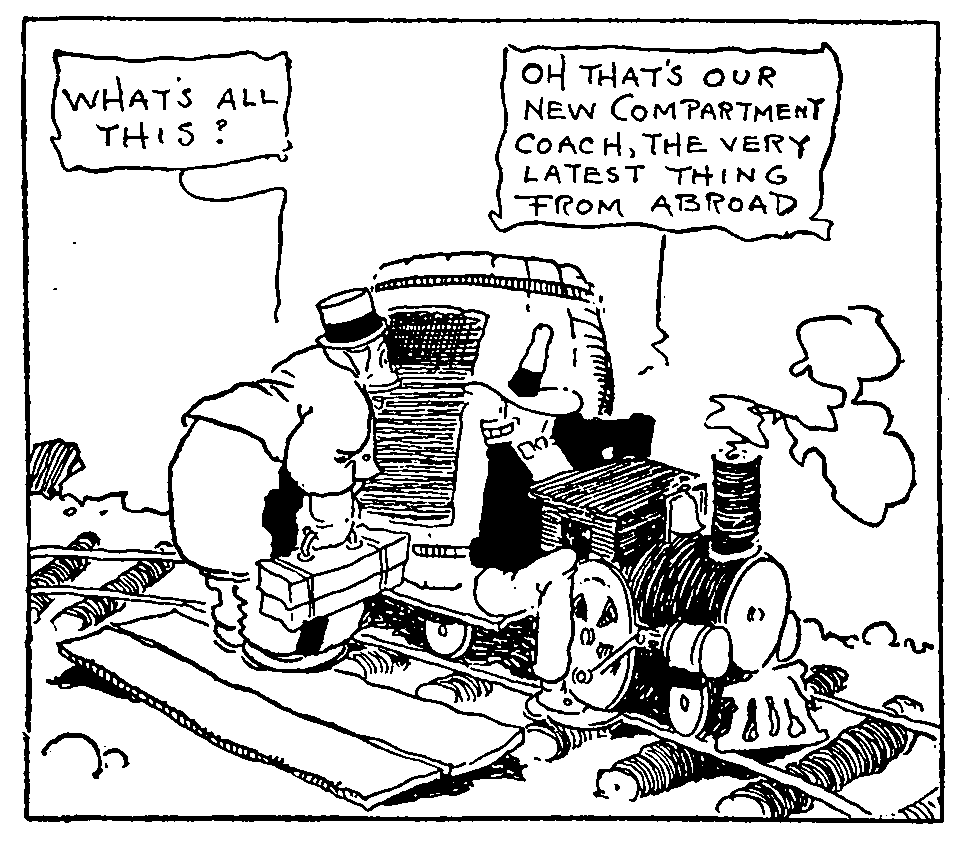
The six panels here, from Bear Creek Folks’ “Off the Track,” are examples of his early work.