
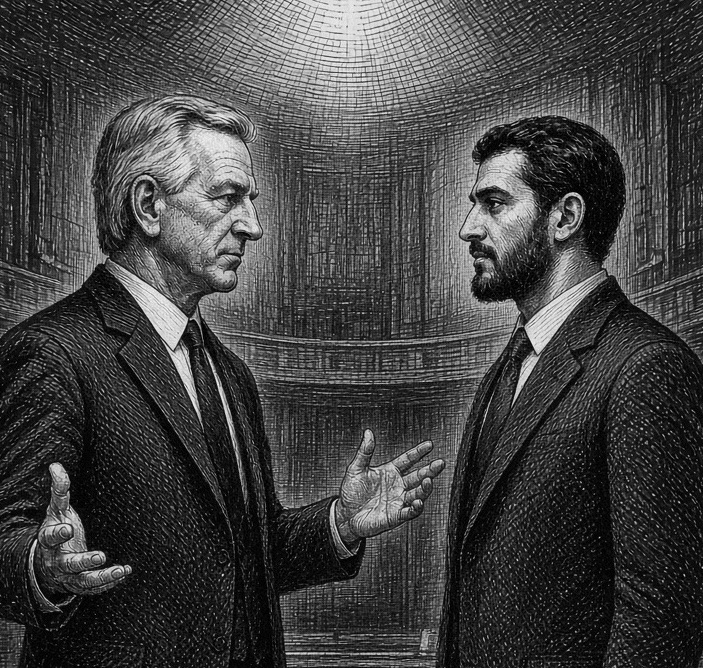
MONTGOMERY, Ala. — U.S. Sen. Tommy Tuberville’s escalating feud with Michigan Senate nominee Abdul El-Sayed has placed the Alabama governor candidate at the center of a national fight over anti-Muslim rhetoric, immigration and the Republican use of “socialism” and “communism” as campaign attacks.
Tuberville, R-Ala., called El-Sayed a “terrorist” and “radical Islamist” after El-Sayed won the Democratic nomination for a U.S. Senate seat in Michigan. El-Sayed, a Muslim American and former Detroit health official, has denied that he seeks to impose Islamic law and said Tuberville’s attacks deliberately target Muslims because of their faith.
The exchange intensified Aug. 24, when El-Sayed appeared on Fox News’ “Jesse Watters Primetime.” Asked about Tuberville’s proposed legislation targeting Sharia law, El-Sayed said, “Nobody is trying to push Sharia law on anyone else, just like I hope nobody is trying to push Canon law on anybody else, because we live in an America where you should have the freedom of your religion.”
El-Sayed then criticized Tuberville’s coaching career, saying the Alabama senator “barely was good at coaching football” and accusing him of deliberately targeting the Muslim community.
Tuberville responded the following day, writing that El-Sayed’s criticism “Sounds like something a terrorist sympathizer would say.”
The confrontation has given Tuberville a national platform as he campaigns for governor against Democratic nominee Doug Jones, a former U.S. senator. But it also has sharpened criticism that Tuberville’s campaign is relying more heavily on fear-based cultural issues than on a detailed discussion of Alabama policy.
Tuberville has described the Alabama governor’s race as a broader fight against “socialism and communism,” rather than simply a contest against Jones.
“I’m not running against Doug Jones,” Tuberville said Aug. 5 on WVNN. “I’m running against an ideology that is sweeping the country, and it’s socialism and communism.”
Tuberville linked that argument to immigration, saying Democrats want “open borders” and “more people here” to remain in power.
He also has blamed illegal immigration for rising consumer prices. In an Aug. 27 interview, Tuberville said, “40 million people need to go home,” referring to people he said are living in the country illegally. He has also suggested Alabama might need to build a 30-foot wall around the state to protect against terrorists if national immigration and election issues are not resolved.
Doug Jones has rejected Tuberville’s use of the term “communist.” The Alabama Democrat said the label was being used to attack him over his opposition to a proposed overhaul of the state’s school-choice program.
The rhetoric reflects a broader Republican campaign strategy this election year in which Democratic candidates are portrayed as socialists, communists, anti-American or sympathetic to terrorism. Tuberville’s comments about El-Sayed have added religion and national security to that message.
Tuberville has introduced federal legislation called the No Sharia Act and the Preserving a Sharia-Free America Act. The proposals would restrict the entry of foreign nationals who advocate Sharia law and address the application of religious law in the United States.
El-Sayed told Fox News that he would “never” seek to impose his faith on another person. He said the First Amendment protects religious freedom for Muslims in the same way it protects members of other faiths.
“The idea, that you have somebody like Tommy Tuberville — who barely was good at coaching football — is out here trying to ban Sharia Law when there’s less than 1% of the Muslim community in America, as if somehow Muslims are out here trying to push Sharia law, that seems to me to be deliberately targeting the Muslim Community, because they’re different,” El-Sayed said.
El-Sayed’s comments came after Republican officials, including Vice President JD Vance and other prominent conservatives, criticized his past statements about Sharia law and other issues. News coverage of the Michigan primary has described a wave of anti-Muslim rhetoric directed at El-Sayed after his nomination.
Tuberville was among the first Republican officials to directly label El-Sayed a terrorist. His remarks were condemned by critics who said there is no evidence that El-Sayed supports terrorism. The Alabama senator has not publicly offered evidence to support the accusation.
Tuberville’s campaign platform includes conservative positions on immigration, public safety, education and social issues. He opposes diversity, equity and inclusion initiatives, opposes transgender rights and supports stricter immigration enforcement. He also backs tax reductions, school choice, gun rights and expanded support for law enforcement.
Those positions have placed transgender people and LGBTQ-related issues within the wider culture-war framework of his campaign, although the recent public exchange with El-Sayed has focused primarily on Islam, Sharia law and terrorism.
Tuberville’s campaign also emphasizes manufacturing, defense, space, agriculture and economic development. His campaign has promoted a plan to review state government operations, including prisons, public safety, transportation, health care, education and economic development.
But the senator’s recent public statements have centered heavily on perceived threats from immigrants, Muslims and the political left. In August, he wrote, “If you hate America, LEAVE,” while criticizing Democrats and people he described as socialists.
Critics say that framing encourages voters to view entire groups as threats rather than addressing specific policy proposals. Tuberville and his supporters argue that the language reflects concerns about border security, national sovereignty, public safety and the direction of the Democratic Party.
The Tuberville-El-Sayed dispute is unusual because neither man is running against the other. El-Sayed is seeking a Senate seat in Michigan, while Tuberville is seeking to become Alabama’s governor.
The feud nevertheless benefits Tuberville’s campaign by reinforcing his national conservative profile and allowing him to present himself as a defender of border enforcement, traditional social policies and opposition to what he calls socialism and communism.
It also has drawn attention away from the Alabama race’s unresolved policy debates, including health care, taxes, education, ethics, economic development and the future of major data-center projects.
Tuberville has said he is unlikely to debate Jones, arguing that Alabama voters already know Jones’ record. Jones has continued to challenge Tuberville on policy and has accused him of avoiding direct scrutiny.
As the November election approaches, the dispute with El-Sayed shows how Tuberville’s campaign is connecting Alabama politics to national Republican attacks on Muslims, immigrants and the political left. Whether that strategy broadens his appeal or deepens concerns about divisive rhetoric remains a central question for Alabama voters.