
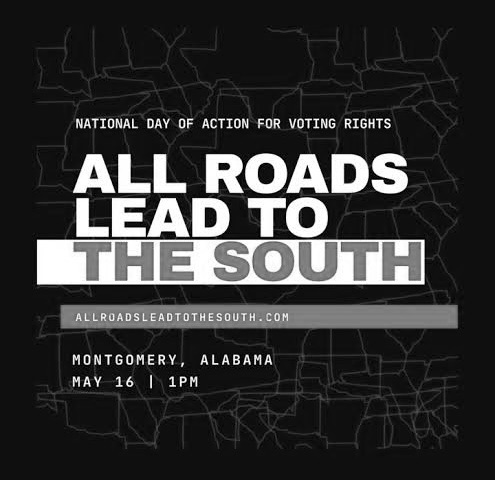
MONTGOMERY, Ala. — Protesters from across Alabama and beyond gathered Saturday in Selma and Montgomery for “All Roads Lead to the South,” a voting rights demonstration organized in response to the Supreme Court’s Louisiana v. Callais ruling and renewed redistricting fights across the South. Organizers said the day was meant to honor the civil rights movement’s legacy while pressing lawmakers to protect Black political power and fair representation.
The protest was expected to begin with prayer and remembrance at the Edmund Pettus Bridge in Selma, then move to a national rally at the Alabama State Capitol in Montgomery, where organizers said buses were bringing participants from cities including Atlanta, Birmingham, Charlotte, Jackson, Memphis, Mobile and Nashville. The demonstrations are tied to Alabama’s special redistricting session and to broader concerns that new maps could weaken majority-Black districts and reduce minority representation.
In Selma, faith leaders and civil rights supporters were scheduled to gather at the Edmund Pettus Bridge for prayer and remembrance, connecting the protest to Bloody Sunday and the broader 1965 march for voting rights. In Montgomery, organizers planned a rally and call to action at the Capitol, with the event framed as a national day of action for voting rights.
Buses and organizing efforts were advertised from multiple Southern cities, and local reporting said participants were coming from Birmingham, Huntsville, Mobile and other places to join the demonstration. The NAACP said more than 90 civil rights, voting rights, faith, labor and community organizations were involved in the effort.
Organizers said their main grievance is that the Callais ruling and related court decisions make it harder to challenge maps that dilute Black voting power. They argued that Republican-led states are moving quickly to redraw congressional maps in ways that could erase Black representation or weaken districts where Black voters can elect candidates of their choice.
They also objected to Alabama’s special session, saying the map-drawing process was moving too fast and could undercut communities already affected by prior redistricting fights. Some organizers framed the issue as part of a broader attack on voting protections across the South, not just in Alabama.
Organizers said the protest was intended to build on the legacy of Selma and Montgomery, with the Edmund Pettus Bridge serving as a symbolic starting point for the action. They said the timing was deliberate, coming as courts and legislatures reopen battles over how race can be considered in drawing districts.
Black Voters Matter and allied groups said the goal is to defend the right to vote and prevent what they describe as a coordinated effort to weaken Black political power. The NAACP said the action was meant to mobilize communities and “build power for the road ahead” after the Supreme Court’s ruling.
The day’s activity included prayer, remembrance, marches and a rally, with organizers also encouraging solidarity actions in other places across the country. Local and national reports said demonstrators were planning to pressure lawmakers, draw attention to the maps, and keep the issue in public view during the special session.
Earlier protests in Montgomery during the redistricting session already led to disruptions at the State House, showing how sharply the issue has divided activists and lawmakers. Republican leaders have said revisiting district lines is appropriate after the Supreme Court ruling, while voting rights advocates say the changes threaten representation for Black voters.