
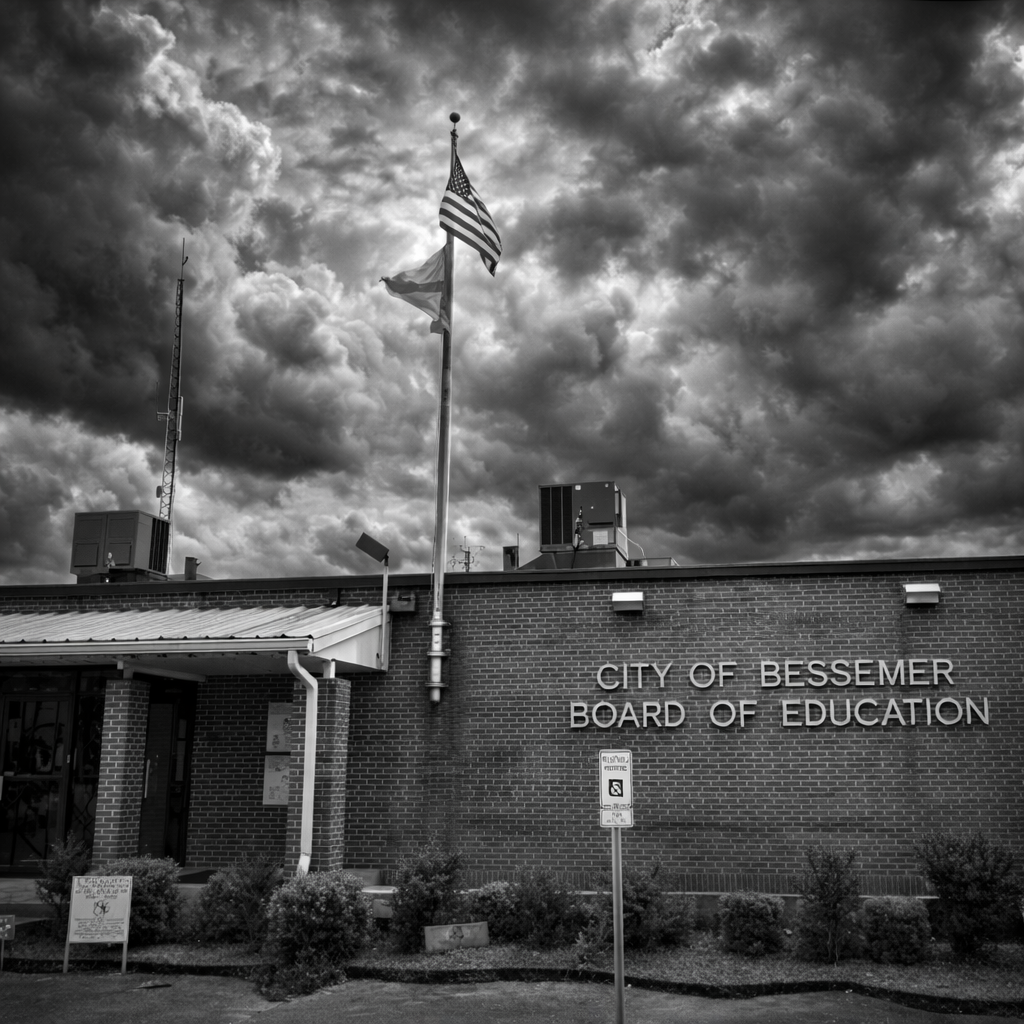
BESSEMER, Ala. — Alabama education officials have suspended the Bessemer City Board of Education from regular meetings and stripped it of governing power, deepening state intervention in a school system based in one of the most crime‑plagued cities in the country.
In internal notices sent this month, board members were told they are “suspended for an indefinite period” while the Alabama State Department of Education and a state‑appointed chief administrator run Bessemer City Schools under the state’s Educational Accountability and Intervention Act. The move follows a 2024 state takeover prompted by what officials described as persistent dysfunction at the board level and long‑standing academic and operational problems.
Bessemer, a city of roughly 25,000 people just southwest of Birmingham, has one of the highest crime rates in the United States, with residents facing a 1 in 10 chance of becoming a victim of violent or property crime, according to an analysis of FBI data by NeighborhoodScout. The city has been ranked among the nation’s most dangerous, with a violent crime rate estimated at about 33 incidents per 1,000 residents and a chance of being a victim of violent crime of about 1 in 30.
Education and public safety experts have long warned that concentrated poverty, unstable school governance and weak academic performance can fuel cycles of crime, though they caution that no single factor explains Bessemer’s statistics. Bessemer’s schools serve many students from low‑income households in neighborhoods where residents have grown accustomed to gun violence, property crime and high incarceration rates.
State Superintendent Eric Mackey persuaded the local board in 2024 to accept intervention after months of what he publicly called “very dysfunctional school board meetings” and ongoing management problems. Mackey said at the time that Bessemer’s academic struggles were “not about lack of resources” or teacher commitment, but about “dysfunction at the top” that was filtering down into classrooms.
The Alabama State Board of Education voted in August 2024 to place Bessemer under formal intervention and named former state superintendent Daniel Boyd as chief administrative officer, giving him legal authority to act for the board and superintendent in “all matters and for all purposes” while the intervention is in effect. Under the law, local board members during an intervention serve only in an advisory role and may meet only when called for specific purposes by the state superintendent or Boyd.
In practice, even that advisory role has now been halted. In a statement released this week, the state Department of Education said Boyd determined that advisory meetings with the Bessemer board “are not offering meaningful input” and that members “have been suspended from regular meetings until further notice.” Officials said each member was notified of the basis for the action, though no formal public suspension order has been posted.
The suspension caps a turbulent year in which the Bessemer board paused regular meetings for several months in 2025, substituted community gatherings while undergoing required training, and faced questions from parents and educators about transparency and delayed decisions on key issues. Regular meetings resumed by late September, and the board approved a multi‑year capital plan to renovate aging facilities and upgrade safety measures.
Despite the governance turmoil, Bessemer City Schools posted its highest grade in years on the state’s annual report card in November, earning a “C” under state oversight after a history of lower ratings. State officials credited added professional development, more consistent procedures and tighter data monitoring for the modest gains, while warning that proficiency remains too low.
Crime remains a constant backdrop. NeighborhoodScout’s analysis found Bessemer’s total crime rate at about 102 offenses per 1,000 residents, far above national averages and higher than the vast majority of communities in Alabama. The site reported that Bessemer experiences one of the higher murder rates in the country when adjusted for population, and that few similarly sized cities have crime rates as high.
Researchers say that when students grow up in communities with high levels of violence and instability, schools must work harder to provide safe environments, consistent instruction and pathways out of poverty — tasks made more difficult when local governance breaks down. In Bessemer, state officials have pointed to board infighting, delayed budgets and interruptions to normal meeting schedules as obstacles to improving academics and school climate.
State leaders say the goal is to stabilize Bessemer’s schools and eventually return control to local officials once governance and student outcomes improve. Mackey has said he believes academics will improve if the “dysfunction at the top” is corrected and that the intervention is intended to be temporary, as in prior takeovers in Sumter County and other systems.
For now, the elected Bessemer board remains in place on paper, but it cannot hold regular meetings or exercise its usual powers, leaving Boyd and the state to make decisions that could shape the city’s schools — and, advocates hope, its crime‑scarred future — for years to come.